If you're in Chicago for MLA 2008, don't miss the NLM theater (Booth 532) as you make your rounds to drop business cards in for iPods & Coach bags while sipping your champagne and eating chocolate dipped strawberries from vendors with enormous marketing budgets! I attended two 20 minute sessions yesterday on what's new & upcoming with PubMed and the relatively recent debut of the NLM Drug Information Portal.
Have you noticed the new Advanced Search (beta) link to the right of the traditional search box in PubMed? Yeah, I hadn't either. Oops. The results I'm currently receiving aren't replicating the all options I remember from the presentation so it may still be a work in progress. New features they displayed include automatic term mapping (ATM), a citation sensor (where recommended citations are featured at the top of results if a search seems to follow that format), enhanced diacritics (no more Americanized äs), and a browser advice section that provides help for users with older versions that aren't compatible with PubMed.
The major change in this beta is the use of ATM in general searches, where they're seeking to move away from being so subject-centric in results (blah blah[MeSH Terms] OR blah blah[Text Word]) by including a range of other options (blah blah[Jour] & a bunch of others I'm not remembering). However, the end result is that more records received when using these ATM search strategies that could be less precise for MyNCBI/RSS feeds and regular users of PubMed are encouraged to use Advanced Search to pare things down may be a good idea. This caused a bit of a ruckus at the presentation I went to and, as always, NLM encourages our feedback by submitting email from the link at the bottom of each page.
Changes that were stated as being in the future with PubMed include MyNCBI data being recoverable, as currently if you forget your login/password you are out of luck, and a My Bibliography feature where authors can create collections of work and save that to search within results. So cool!
I forgot to take notes at the NLM Drug Information Portal, but if you haven't previously checked it out definitely add it to your pharmaceutical toolkit! It's pretty straightforward to play around in the tabs to see what's there, but a feature currently in development is a pill identifier similar to the one at drugs.com. They warned it may be a few months before that section goes live because it's pretty detailed work to take high quality photos of all those pills then map them to all the different shapes, colors and sizes they're in!

Monday, May 19, 2008


Sunday, May 11, 2008
Probably not even worthy of the C list: HMO searching for Web 2.0 mentions and responding
In the midst of celebrating Mother's Day and packing for a trip tomorrow, I noticed an article in the paper today that reminded me of a bioethics librarian's recent post about privacy concerns with social bookmarking on a medical library website.
What, if anything, would you write differently in your blog, bookmark on del.icio.us, tweet on Twitter or otherwise communicate online if you knew your physician was reading it? What if you were part of a 'daily roundup' of mentions of your health maintenance organization (HMO) measured by your site traffic and 'comment tone'?
According to the Seattle Times, if you belong to my HMO you may be part of the roundup.
Note how I am carefully not mentioning said HMO by name here. Also note the newspaper's bias by word choice in the headline. However, this section regarding physicians does not settle well with me.
I certainly stand by First Amendment rights to free speech and the fact that the internet is anything but private, but am very concerned about the possible integration of said free speech into my print or electronic medical records (EMR). In other words, if I "reveal information" I "never would share with" my physician in my blog and my physician reads it, is he or she then permitted to paste it into my EMR without my knowledge or consent? Send me an email or post a comment about it? EMR records are available to quite a few other entities besides my physician I have a strong relationship with, ranging from insurance agencies to snooping hospital employees. If I bookmark a bunch of websites about Dance Dance Revolution or bacon in del.icio.us that are easily accessible via a widget in my blog, will I be asked about any lifestyle or dietary changes at my next office visit?
If I do happen to make the C list at my HMO, can you please tell me my medlib colleagues there are not the ones conducting this daily search and while these roundups probably don't hold up to the same level as protected health information (PHI) that they aren't left in the break room for casual discussion either?
What, if anything, would you write differently in your blog, bookmark on del.icio.us, tweet on Twitter or otherwise communicate online if you knew your physician was reading it? What if you were part of a 'daily roundup' of mentions of your health maintenance organization (HMO) measured by your site traffic and 'comment tone'?
According to the Seattle Times, if you belong to my HMO you may be part of the roundup.
[The HMO] monitors cyber chatter with more vigilance than most major health plans in Washington. A staff member compiles a daily roundup of postings that mention the co-op. Each Web site is ranked by traffic volume. (Major news sources such as CNN.com are on the A list, while obscure blogs rate a C.) Each comment is rated for tone: negative ("Shame on you, [HMO]"); positive ("I feel like a human being here, not a number"); neutral; or mixed.
Note how I am carefully not mentioning said HMO by name here. Also note the newspaper's bias by word choice in the headline. However, this section regarding physicians does not settle well with me.
[Dr. E], the [HMO] physician, goes as far as to believe that blogs could offer direct clinical benefits. [Dr. E] has read patients' personal blogs, in which, he said, they reveal information they never would share with their doctors.
If doctors can find a way to harness such hidden insights, they can better tackle the root causes of ailments, [Dr. E] said. He added that doctors ought to welcome patients who seek health information elsewhere — even if they sometimes consult dubious sources.
I certainly stand by First Amendment rights to free speech and the fact that the internet is anything but private, but am very concerned about the possible integration of said free speech into my print or electronic medical records (EMR). In other words, if I "reveal information" I "never would share with" my physician in my blog and my physician reads it, is he or she then permitted to paste it into my EMR without my knowledge or consent? Send me an email or post a comment about it? EMR records are available to quite a few other entities besides my physician I have a strong relationship with, ranging from insurance agencies to snooping hospital employees. If I bookmark a bunch of websites about Dance Dance Revolution or bacon in del.icio.us that are easily accessible via a widget in my blog, will I be asked about any lifestyle or dietary changes at my next office visit?
If I do happen to make the C list at my HMO, can you please tell me my medlib colleagues there are not the ones conducting this daily search and while these roundups probably don't hold up to the same level as protected health information (PHI) that they aren't left in the break room for casual discussion either?
Tuesday, May 6, 2008
Week 8 assignment: Mashups & API
I have been waiting 5 days to post this week's assignment because I wanted to review HubMed. It was not until today that I realized HubMed wouldn't work in Firefox and I had to review it with Internet Explorer, which I do not consider acceptable since multiple-browser functionality is key in the 21st century!
I entered my standard not-so-popular search query (Lofgren's Syndrome, something I personally do not recommend having although it's considered the most desirable form of sarcoidosis) side-by-side in HubMed and PubMed and was pleased to see 152 identical results retrieved in the same order. When I tried to resort my results my relevance (something I'm rather curious about, how is this determined?) I received the same dreaded 500 Internal Server Error I did each time I tried searching HubMed in Firefox, which was disappointing. I also wasn't so impressed with the options in HubMed as MyNCBI offers much of the same except for tagging and the proprietary Scopus information for Elsevier subscribers. Perhaps this was all the rage a few years ago but is no longer?
I do like the idea behind creating your own quasi-meta search engine with source information from websites of your choosing using Rollyo though. I would be curious to know more about what algorithms they use to display search results so I can understand their relevance ranking, but I'm also certain their competitors would love to know that as well! A simple search of 'privacy' is difficult to measure the full context of due to its many meanings (patron privacy? privacy policies on websites? outdoor privacy screens thanks to 'sponsored links' aka advertising mixed in with the regular results?) but if there were certain MeSH, jargon or other terms that weren't so ambiguous and commonly mentioned in a select variety of resources this could be a fun & useful way to look for them.
This concludes my assignments for the MLA CE! I will try to update regularly from here on out with various medlib issues, but at the moment I've completed my third day on my first job in my medical library career and it's quite a whirlwind of information. I am hopeful things will settle down later this month!
I entered my standard not-so-popular search query (Lofgren's Syndrome, something I personally do not recommend having although it's considered the most desirable form of sarcoidosis) side-by-side in HubMed and PubMed and was pleased to see 152 identical results retrieved in the same order. When I tried to resort my results my relevance (something I'm rather curious about, how is this determined?) I received the same dreaded 500 Internal Server Error I did each time I tried searching HubMed in Firefox, which was disappointing. I also wasn't so impressed with the options in HubMed as MyNCBI offers much of the same except for tagging and the proprietary Scopus information for Elsevier subscribers. Perhaps this was all the rage a few years ago but is no longer?
I do like the idea behind creating your own quasi-meta search engine with source information from websites of your choosing using Rollyo though. I would be curious to know more about what algorithms they use to display search results so I can understand their relevance ranking, but I'm also certain their competitors would love to know that as well! A simple search of 'privacy' is difficult to measure the full context of due to its many meanings (patron privacy? privacy policies on websites? outdoor privacy screens thanks to 'sponsored links' aka advertising mixed in with the regular results?) but if there were certain MeSH, jargon or other terms that weren't so ambiguous and commonly mentioned in a select variety of resources this could be a fun & useful way to look for them.
This concludes my assignments for the MLA CE! I will try to update regularly from here on out with various medlib issues, but at the moment I've completed my third day on my first job in my medical library career and it's quite a whirlwind of information. I am hopeful things will settle down later this month!
Sunday, April 27, 2008
"Clinical Plagiarism": Calling EMR copy/paste what it is
Although I'm headed into traditional medical librarianship, being in the thick of healthcare IT for years has left an indelible impression on me. Granted, most of that time I had no earthly clue exactly how the different components I was ordering in my purchasing role to the tune of millions of dollars to avert zomg Y2K!1!!!1!! were or how all the billing systems worked with one another, but during my health informatics classes I had way too many moments of Oh! THAT'S what that was about! I still remember an Ask Me About HL7 button someone had in his office a decade ago, then last year in an agonizing class... there was HL7. Aie! Flashbacks!
As a result of all that, I'm acutely sensitive to the issues surrounding electronic health or medical records (EHRs or EMRs). I'm still not seeing a clear trend in definitions to distinguish one from the other so my own preference is EMR. Whenever I see anyone writing about EMRs, I am usually there. I love seeing the issues from as many viewpoints as possible because there is so much concern and so little agreement over just about every component of them.
One concern I have seen mentioned repeatedly as both a praise (saving time, improving accuracy, insurance coding) and a caution (reducing accuracy due to copying wrong info) is the ability to copy descriptive text that is frequently used in patient records. I have seen some modified versions of this happening as part of my own healthcare, although without grilling the medical staff it appeared to be the use of pre-formatted template wording from one section of my EMR to another that didn't have a template.
Today I read a post in Health Care Renewal, a group blog concerned with "Addressing threats to health care's core values, especially those stemming from concentration and abuse of power" that highlighted a term for this phenomenon from a New England Journal of Medicine editorial that put an entirely different light on it for me: Clinical plagiarism.
It could be that I'm so recently from grad school where we had the Fear of Plagiarism drilled into us more than anything else, but the more I think about it the more I agree with calling a spade a spade. We expect students to research the literature and case studies, but come up with their own terms and thoughts while properly citing their resources. Why should we expect any less from our doctors? Do we want to be the patient who is either copied or pasted, with whatever makes our medical history unique and 'off the charts' (i.e. no standard template wording exists for what we have going on) either carried forward or someone else's information accidentally given to us without our knowledge? Consumer views of EMRs are not full compendiums of medical data and terminology and generally offer summaries of lab tests, after-visit summaries and related material in regular language.
These are the things that keep me up at night if I'm not careful.
As a result of all that, I'm acutely sensitive to the issues surrounding electronic health or medical records (EHRs or EMRs). I'm still not seeing a clear trend in definitions to distinguish one from the other so my own preference is EMR. Whenever I see anyone writing about EMRs, I am usually there. I love seeing the issues from as many viewpoints as possible because there is so much concern and so little agreement over just about every component of them.
One concern I have seen mentioned repeatedly as both a praise (saving time, improving accuracy, insurance coding) and a caution (reducing accuracy due to copying wrong info) is the ability to copy descriptive text that is frequently used in patient records. I have seen some modified versions of this happening as part of my own healthcare, although without grilling the medical staff it appeared to be the use of pre-formatted template wording from one section of my EMR to another that didn't have a template.
Today I read a post in Health Care Renewal, a group blog concerned with "Addressing threats to health care's core values, especially those stemming from concentration and abuse of power" that highlighted a term for this phenomenon from a New England Journal of Medicine editorial that put an entirely different light on it for me: Clinical plagiarism.
It could be that I'm so recently from grad school where we had the Fear of Plagiarism drilled into us more than anything else, but the more I think about it the more I agree with calling a spade a spade. We expect students to research the literature and case studies, but come up with their own terms and thoughts while properly citing their resources. Why should we expect any less from our doctors? Do we want to be the patient who is either copied or pasted, with whatever makes our medical history unique and 'off the charts' (i.e. no standard template wording exists for what we have going on) either carried forward or someone else's information accidentally given to us without our knowledge? Consumer views of EMRs are not full compendiums of medical data and terminology and generally offer summaries of lab tests, after-visit summaries and related material in regular language.
These are the things that keep me up at night if I'm not careful.
Week 7 assignment: Podcasting & Online Hosted Video
Write a blog entry discussing how you felt about the experience of using YouTube and what you think about this service. Do you see any potential uses for Podcasting in the library? If so what and why?
YouTube has long been the I have a commercial/some Muppets show/random bit of pop culture stuck in my brain and I must see it NOW if it's ever going to leave resource, although it's heartening to see some more serious fare on it over the last few years. I certainly don't have official stats but usage counts I'm seeing still seem to support the casual surfing use with some questionable copyrighted material issues along the way.
I still believe that most medical libraries will choose to publish any audio/video content they create with Camtasia or other screen-capture recordings on internal servers to publish on their own websites. This clearly indicates a "for educational use only" context that (usually with permission) avoids possible copyright ruckus with vendors regarding screenshots of their products. I see the same situation for podcasts for cataloging/class webpage-linking purposes and control in case of revisions or corrections.
For my video post, I want to bring to your recollection Randy Pausch, the Carnegie Mellon professor with pancreatic cancer who gave an amazing last lecture in September 2007 when he was told he had a maximum of 6 months of good health left.
He's passed that mark and still alive and testifying before Congress. He also filmed a public service announcement (PSA) for the Pancreatic Cancer Action Network. He closed with The human spirit is much more powerful than any biological disease. Indeed.
YouTube has long been the I have a commercial/some Muppets show/random bit of pop culture stuck in my brain and I must see it NOW if it's ever going to leave resource, although it's heartening to see some more serious fare on it over the last few years. I certainly don't have official stats but usage counts I'm seeing still seem to support the casual surfing use with some questionable copyrighted material issues along the way.
I still believe that most medical libraries will choose to publish any audio/video content they create with Camtasia or other screen-capture recordings on internal servers to publish on their own websites. This clearly indicates a "for educational use only" context that (usually with permission) avoids possible copyright ruckus with vendors regarding screenshots of their products. I see the same situation for podcasts for cataloging/class webpage-linking purposes and control in case of revisions or corrections.
For my video post, I want to bring to your recollection Randy Pausch, the Carnegie Mellon professor with pancreatic cancer who gave an amazing last lecture in September 2007 when he was told he had a maximum of 6 months of good health left.
He's passed that mark and still alive and testifying before Congress. He also filmed a public service announcement (PSA) for the Pancreatic Cancer Action Network. He closed with The human spirit is much more powerful than any biological disease. Indeed.
Friday, April 18, 2008
Week 6 assignment: Online photo sharing
Blog about the process [uploading online photos] on your personal blog for this course and share how this concept might be used in your library.
Are you sure you can handle this? The instructions were to upload a picture to our Facebook account and our blog, and I did... although only you, dear readers, get the full scope of what I was up to this afternoon:
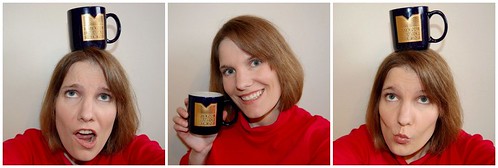
The beauty of the Flickr preview is that all may not necessarily be as it seems. This is a triptych created with an external Mosaic Maker and if someone were to see a preview it only shows the middle picture where I look perfectly normal. That middle picture is also the one I put on Facebook.
The other two are rather reflective of my state of mind as I'm realizing that the past 10 years of my completely-non-library career aren't relevant to my medical library job that I'm starting on May 1st. It's a good change, absolutely, but a strange one to process on a cognitive level. How can a decade of work not matter and the slate be wiped clean to begin again when I already feel so old?
Oh wait, my personal reflections are not part of the assignment. My bad.
As for how Flickr could be used in our particular library, I'm not all that convinced it would. What medical images we do have in an academic medical library are tucked in both proprietary and open access databases with a variety of search methods available, cataloging structures, and vast quantities of storage space. If we have any unorganized and unpublished images in our collection that aren't under copyright, we'd probably create our own database to manage them (like these) instead of using Flickr. I didn't realize the American Social Hygiene posters existed before now and am off to have some fun surfing those!
Are you sure you can handle this? The instructions were to upload a picture to our Facebook account and our blog, and I did... although only you, dear readers, get the full scope of what I was up to this afternoon:
The beauty of the Flickr preview is that all may not necessarily be as it seems. This is a triptych created with an external Mosaic Maker and if someone were to see a preview it only shows the middle picture where I look perfectly normal. That middle picture is also the one I put on Facebook.
The other two are rather reflective of my state of mind as I'm realizing that the past 10 years of my completely-non-library career aren't relevant to my medical library job that I'm starting on May 1st. It's a good change, absolutely, but a strange one to process on a cognitive level. How can a decade of work not matter and the slate be wiped clean to begin again when I already feel so old?
Oh wait, my personal reflections are not part of the assignment. My bad.
As for how Flickr could be used in our particular library, I'm not all that convinced it would. What medical images we do have in an academic medical library are tucked in both proprietary and open access databases with a variety of search methods available, cataloging structures, and vast quantities of storage space. If we have any unorganized and unpublished images in our collection that aren't under copyright, we'd probably create our own database to manage them (like these) instead of using Flickr. I didn't realize the American Social Hygiene posters existed before now and am off to have some fun surfing those!
Tuesday, April 15, 2008
I fear change, I will keep my bushes: EBM, email & human nature
My husband just made fun of me for trying to find a Quizno's commercial from the turn of the century without success.
(May 12, 2009 edit: Bless you Xyc0, you have FOUND THE VIDEO!!)
Perhaps you remember it. The opening dialog is betweentwo three primitively dressed British actors (and another standing around) at a ranch on the outskirts of Los Angeles (no, really), one wearing pants with the others holding on to what looks like a tumbleweed for apparel, and they meet and greet one another...
Primitive Brit 1: Aah! You are cursed with the legs of a goat!
Primitive Brit 2: Nay, these are pants! No more thorns and bugs!
Primitive Brit 1: I'd like to wear pants!
Primitive Brit 3: I fear change, and I will keep my bushes.
The part about hanging on to the tumbleweed because of fearing change has been on my mind today. I have read, re-read and am still pondering a blog entry from yesterday that caught my attention via Kevin MD about evidence-based medicine (EBM) and the difficulty in persuading physicians to change their practice. I cannot summarize the historical background quickly so please give it a read if you're curious about how long it took between the first randomized control trial (RCT) & setting best practice standards (hint: 1 century is about halfway there) and while we may promote EBM to resistant audiences, we're unlikely to die in a 19th century insane asylum in part due to physician resistance to installing plumbing for handwashing (RIP Dr. Semmelweis, we're still fighting ventilator-associated pneumonia (VAP) and Methicillin-resistant Staphylococcus aureus (MRSA) over the same thing).
What really got my attention was this section, based in part on Asch SM, Kerr EA, Keesy J et al., Who is at greatest risk for receiving poor quality health care? New England Journal of Medicine, 2006 Mar 16;354(11):1147-56.
Resistance to change, however, is an undeniable part of human nature that is most successfully overcome through extreme patience, persistence and education in conjunction with assessing user information needs (before, during & after) to determine the proposed changes will/are actually work(ing). In our MLA class we had an episode last week where, despite being instructed to post blog entries or contact our online instructors via chat with gentle reminders along the way, there was an outbreak of using an email listserv to communicate participant thoughts regarding the class. The listserv manager finally limited postings to instructors because the emails were becoming way too numerous.
I find this fascinating: we, as medical librarians and agents of change (I need a badge), in a class specifically for learning about new online communication technologies... went straight back to the familiar standard email listserv without hesitation even when we were told not to do so from the beginning.
Wow. Talk about fearing those goat legs and hanging onto the tumbleweeds in the face of change! I hope the class remembers this listserv stint when we experience difficulty in reaching/teaching our users regarding EBM (and other changes) though. We have great curriculum sources such as the EBM Librarian Wiki, but it takes time and knowledge of your users to teach new ways of practice. I think this is especially true when it comes to students who are learning from clinicians who have 'always done it this way.' If there's too much, too fast or any semblance 'you're doing it wrong' as part of the instruction to a group of people who are given a high level of societal power... well, it's not exactly surprising that hospital libraries are closing because they aren't perceived as valuable, is it? At least they haven't carted the librarians off to the insane asylum (yet)!
(May 12, 2009 edit: Bless you Xyc0, you have FOUND THE VIDEO!!)
Perhaps you remember it. The opening dialog is between
Primitive Brit 1: Aah! You are cursed with the legs of a goat!
Primitive Brit 2: Nay, these are pants! No more thorns and bugs!
Primitive Brit 1: I'd like to wear pants!
Primitive Brit 3: I fear change, and I will keep my bushes.
The part about hanging on to the tumbleweed because of fearing change has been on my mind today. I have read, re-read and am still pondering a blog entry from yesterday that caught my attention via Kevin MD about evidence-based medicine (EBM) and the difficulty in persuading physicians to change their practice. I cannot summarize the historical background quickly so please give it a read if you're curious about how long it took between the first randomized control trial (RCT) & setting best practice standards (hint: 1 century is about halfway there) and while we may promote EBM to resistant audiences, we're unlikely to die in a 19th century insane asylum in part due to physician resistance to installing plumbing for handwashing (RIP Dr. Semmelweis, we're still fighting ventilator-associated pneumonia (VAP) and Methicillin-resistant Staphylococcus aureus (MRSA) over the same thing).
What really got my attention was this section, based in part on Asch SM, Kerr EA, Keesy J et al., Who is at greatest risk for receiving poor quality health care? New England Journal of Medicine, 2006 Mar 16;354(11):1147-56.
I'm not certain I would agree with the author's inclusion of "we desperately need electronic medical records" (EMRs) because without careful user needs assessment, research, integration & training EMRs can backfire just as easily as whatever the latest 'ooh!' technology toy du jour does. There is not currently and I doubt there can be a one-size-fits-all EMR (we won't even touch the hot potato clinical decision support systems (CDSS) part of the equation!) as long as we have so many different key players in the health care industry."The gap between what we know works and what is actually done is substantial enough to warrant attention," the NEJM study concluded.
"What can we do to break through this impasse?" the researchers asked. "Given the complexity and diversity of the health care system, there will be no simple solution. A key component of any solution, however, is...to make information available...with a focus on automating the entry and retrieval of key data for clinical decision making and for the measurement and reporting of quality." In other words, we desperately need electronic medical records, and the data from those records needs to be consolidated in order to establish benchmarks for performance and best practice guidelines.
But even the best healthcare information technology will not help if physicians resist the fact that medical knowledge is constantly changing, Lalvani points out. Too often, physicians stick to the treatments they have always used, declaring that if tens of thousands of physicians do it this way, it must work.
Resistance to change, however, is an undeniable part of human nature that is most successfully overcome through extreme patience, persistence and education in conjunction with assessing user information needs (before, during & after) to determine the proposed changes will/are actually work(ing). In our MLA class we had an episode last week where, despite being instructed to post blog entries or contact our online instructors via chat with gentle reminders along the way, there was an outbreak of using an email listserv to communicate participant thoughts regarding the class. The listserv manager finally limited postings to instructors because the emails were becoming way too numerous.
I find this fascinating: we, as medical librarians and agents of change (I need a badge), in a class specifically for learning about new online communication technologies... went straight back to the familiar standard email listserv without hesitation even when we were told not to do so from the beginning.
Wow. Talk about fearing those goat legs and hanging onto the tumbleweeds in the face of change! I hope the class remembers this listserv stint when we experience difficulty in reaching/teaching our users regarding EBM (and other changes) though. We have great curriculum sources such as the EBM Librarian Wiki, but it takes time and knowledge of your users to teach new ways of practice. I think this is especially true when it comes to students who are learning from clinicians who have 'always done it this way.' If there's too much, too fast or any semblance 'you're doing it wrong' as part of the instruction to a group of people who are given a high level of societal power... well, it's not exactly surprising that hospital libraries are closing because they aren't perceived as valuable, is it? At least they haven't carted the librarians off to the insane asylum (yet)!
Subscribe to:
Posts (Atom)